
Starting a Private-Pay Medical Practice? What to Decide Before You Start Marketing


When healthcare providers start thinking about launching a private-pay medical practice, one of the first questions is usually about marketing.
How am I going to get patients?
It makes sense. If you're leaving a hospital system, converting an existing practice, or building a new model from scratch, you need people to understand what you offer and why they should choose it. Ironically, marketing is not always the first problem to solve.
Before you decide how to promote a private-pay medical practice, you need to make a series of decisions about the business you are actually bringing to market. This is where go-to-market strategy becomes important.
You aren't simply asking someone to find a doctor. You are asking them to understand why this particular model of care is worth paying for.
Your Go-to-Market Strategy Starts Before Your Marketing Plan
A business plan helps you define and structure your practice. A marketing plan helps you decide where to become visible, which channels to use, what kind of content to create and how to generate demand.
A go-to-market strategy starts earlier. It looks at who the practice is for, what problem the patient is paying you to solve, what exactly you're offering, how the service should be structured, what patients are willing to pay for it and why they would choose your model instead of staying with insurance or selecting another physician.
Those questions become especially important when patients are making a meaningful out-of-pocket investment in their care. You aren't simply asking someone to find a doctor. You are asking them to understand why this particular model of care is worth paying for.
Start With the Market, Not the Website
One of the common mistakes I see when a new medical practice is getting ready to launch is that the website becomes the starting point.
The physician needs a name, branding, a website, SEO, maybe paid advertising, perhaps a social media presence. All of those things may eventually be necessary, but a website can't solve a business model that hasn't been set yet.
Before you invest heavily in marketing, you need to understand the market you are entering.
Who are the alternatives?
What are patients doing now?
Where is there unmet demand?
How are other practices positioned?
And most importantly, is there a group of patients with both the need and the willingness to pay for the care you want to provide?
This is one of the places where a medical practice startup consultant can be useful. The role is not simply to recommend more marketing. It's to help you determine if the underlying business decisions are strong enough for the marketing to work.
Clarify the Patient Before You Define the Message
From my experience, private-pay practices often tend to describe their audience too broadly.
Phrases such as “busy professionals,” “people who want better care,” or “patients who are frustrated with the healthcare system” are commonly used. and while those descriptions may be true, they usually are not specific enough to guide a healthcare go-to-market strategy.
A stronger patient definition considers the circumstances that make someone willing to look for an alternative in the market. Maybe they have a complex condition that has not been adequately addressed. Maybe access and continuity matter more to them than insurance coverage. Or perhaps they value deeper expertise, longer appointments, privacy, convenience or a more personalized relationship with their physician.
Those motivations influence much more than the marketing message. They can influence the service model itself.
The Commercial Model Is Part of the Strategy
Private-pay medical practices also have to make decisions that sit outside traditional marketing.
Should the practice use concierge-type membership pricing or fee-for-service?
What needs to be included for the price to make sense?
How many patients are required for the model to work?
Which services should lead?
Should the practice serve a narrow specialty population or a broader group?
If an existing physician is converting a panel, which patients are most likely to follow?
These are commercial decisions.
They affect the viability of the practice long before you choose an SEO strategy or advertising channel. If the commercial model is not clear, you can easily spend money generating attention for an offer that patients do not immediately understand or value.
Positioning Comes Before Visibility
Once the market, patient and commercial model are clearer, positioning becomes easier.
Positioning answers a basic question: why should the right patient choose this practice?
For a private-pay physician, clinical credentials matter, but credentials alone may not explain the value of the model. Patients may also be evaluating expertise, access, experience, convenience, trust, philosophy of care, perceived outcomes and whether the physician appears to understand the specific problem they are trying to solve.
This becomes even more important when you are serving affluent patients who have multiple alternatives and the financial ability to choose among them. In that environment, more visibility does not necessarily solve the problem. You first need to give patients a reason to choose you.
Then You Can Decide How to Create Demand
Only after those decisions are clearer would I determine how the practice should be marketed. That might include search visibility, local SEO, referrals, physician relationships, thought leadership, LinkedIn, paid ads, events or other channels. The specific mix will depend on the practice, the patient and the market.
The sequence I generally use is:
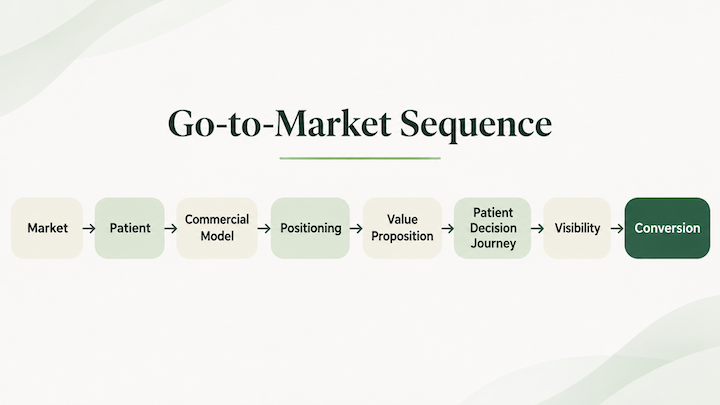
That sequence helps prevent a very common mistake: investing in marketing activity before deciding what the marketing is actually supposed to accomplish.
When a Medical Practice Startup Consultant Can Help
Sometimes you do need a marketing agency. If the business model is clear, the positioning is strong and you already know what needs to be executed, an agency may be exactly the right partner.
But if you are still trying to determine what to offer, whom to target, how to price it, how to position the practice or what patients need to understand before they choose you, the problem may sit upstream from marketing. That is where medical practice consulting can be useful.
The question is not simply, “How should I market my practice?”
A better question is: What am I actually bringing to market, and what needs to be true for patients to choose it?
That distinction matters because the answer may change what you market, how you structure the offer and even who the practice is really for.
If you are starting or repositioning a private-pay medical practice and want help thinking through those questions, a Strategic Direction Call can help identify what deserves attention before you invest further in marketing or execution.
Frequently Asked Questions
What does a medical practice startup consultant do?
A medical practice startup consultant can help clarify the strategic decisions involved in launching a practice, including the target patient, service model, pricing, positioning, patient acquisition and go-to-market strategy.
Is go-to-market strategy the same as marketing strategy?
No. Go-to-market strategy looks at what you are bringing to market, for whom and how the business will create demand. Marketing strategy focuses more specifically on how you communicate that value and become visible.
When should I start marketing a new medical practice?
Marketing can begin before launch, but the core business model, target patient, positioning and value proposition should be sufficiently clear first.
Is this different for a private-pay medical practice?
Yes. When patients are paying directly, they need to understand why the care is worth the investment. Pricing, perceived value, trust and patient choice become more important.
Do I need a business plan before opening a medical practice?
You need clarity around the business model and economics, although that does not necessarily mean you need a traditional formal business plan before making every growth or marketing decision.
Should I hire a consultant or a marketing agency?
If you know what needs to be executed, an agency may make sense. If you are still deciding what the practice should offer, how it should be positioned or how the model should grow, consulting may need to come first.


