
SEO for Therapists in an AI-Driven Search Environment

Updated: Jun 24


Why Visibility Alone No Longer Guarantees Trust or Growth
Many private-pay therapists are working harder to stay visible online and still feeling less predictable than they did a few years ago. They're creating more content, updating their websites, investing in SEO, and still feeling less predictable than they did a few years ago. The issue is that search behavior has changed, and visibility alone is no longer enough.
Today, clients are no longer discovering therapists through one platform, one directory, or one Google search. They're researching across multiple touchpoints before they ever reach out. They compare websites, Psychology Today profiles, reviews, blogs, Google Business Profiles, podcast interviews, and increasingly, AI-generated summaries.
That means SEO for therapists now functions differently than it did even a few years ago.
SEO is no longer simply about getting found online. It's about helping search engines, AI systems, and potential clients correctly understand what your practice does, who you help, and why someone should trust you.
What SEO for Therapists Actually Means Today
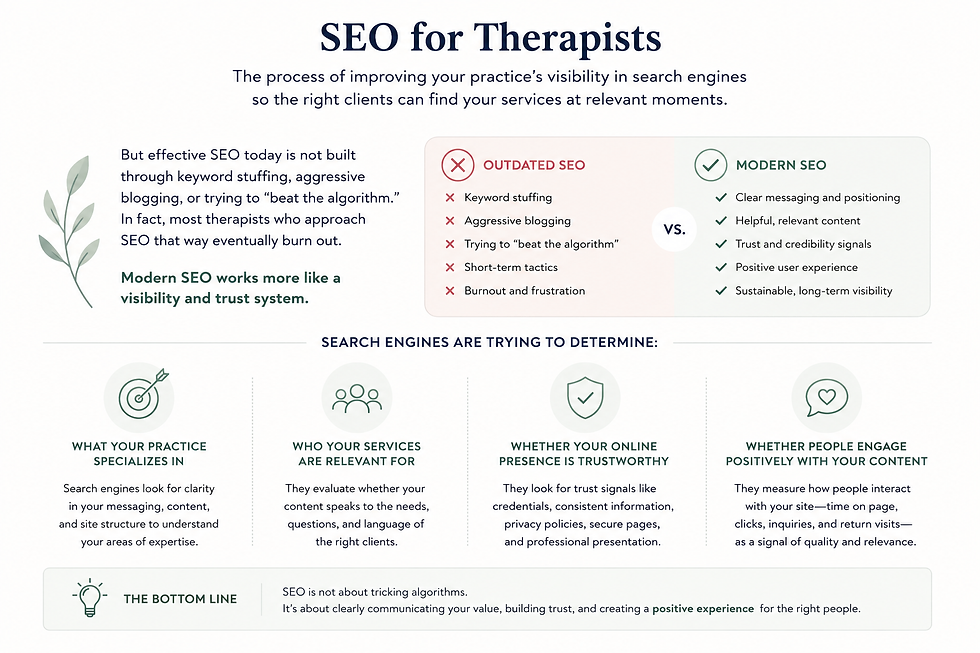
SEO for therapists refers to the process of improving your practice’s visibility in search engines so the right clients can find your services at relevant moments.
But effective SEO today is not built through keyword stuffing, aggressive blogging, or trying to “beat the algorithm.” In fact, most therapists who approach SEO that way eventually burn out. Modern SEO works more like a visibility and trust system.
Search engines are trying to determine:
what your practice specializes in
who your services are relevant for
whether your online presence is trustworthy
and whether people engage positively with your content.
This is especially important for private-pay practices.
When someone is considering paying out-of-pocket for therapy, they are evaluating far more than availability. They are evaluating professionalism, specialization, trust, and fit.
That means your online presence must create clarity.
Why online Visibility Alone No Longer Works
For years, many therapists could build a relatively stable practice through a combination of colleague referrals, a Psychology Today profile, a simple website, and basic online visibility. In many cases, that was enough to maintain a steady stream of inquiries without needing a sophisticated marketing strategy.
And while those things still matter, clients' way of searching for therapy services has changed significantly.
Today, many potential clients:
Google symptoms and concerns
compare therapists across multiple platforms
read blog content before reaching out
ask AI-generated follow-up questions
and form impressions before making contact.
By the time someone lands on your website, they are often no longer casually browsing.
They're evaluating compatibility. That means your visibility strategy must support:
positioning
clarity
trust
and consistency.
This is one reason therapists sometimes feel frustrated by SEO. They may be technically visible online while still attracting poor-fit inquiries or inconsistent leads. These are the results of an outdated SEO optimization model that focused on volume traffic.
Today, the issue is not merely visibility, but interpretability.
The practices that are easiest to understand and trust often become the easiest to find.
Understanding SEO as Interpretability
One of the biggest shifts happening right now is that search engines and AI systems are increasingly trying to interpret practices instead of just indexing websites. That changes how visibility works. The problem is that most of us haven't fully adapted to this method yet.
Here's how search systems now evaluate:
how clearly your services are explained
whether your messaging is consistent
how your practice is described across platforms
whether your expertise appears specialized
and whether users engage with your content.
In other words, search engines are increasingly asking:
“Do we understand what this practice does and who it helps?”
And not merely:
“Does this website contain keywords?”
This is why vague positioning often weakens SEO performance. When a therapy website sounds interchangeable, broad, or unclear, search systems struggle to confidently associate it with specific client searches. Strong SEO begins with strong positioning.
Why Positioning Matters Before SEO
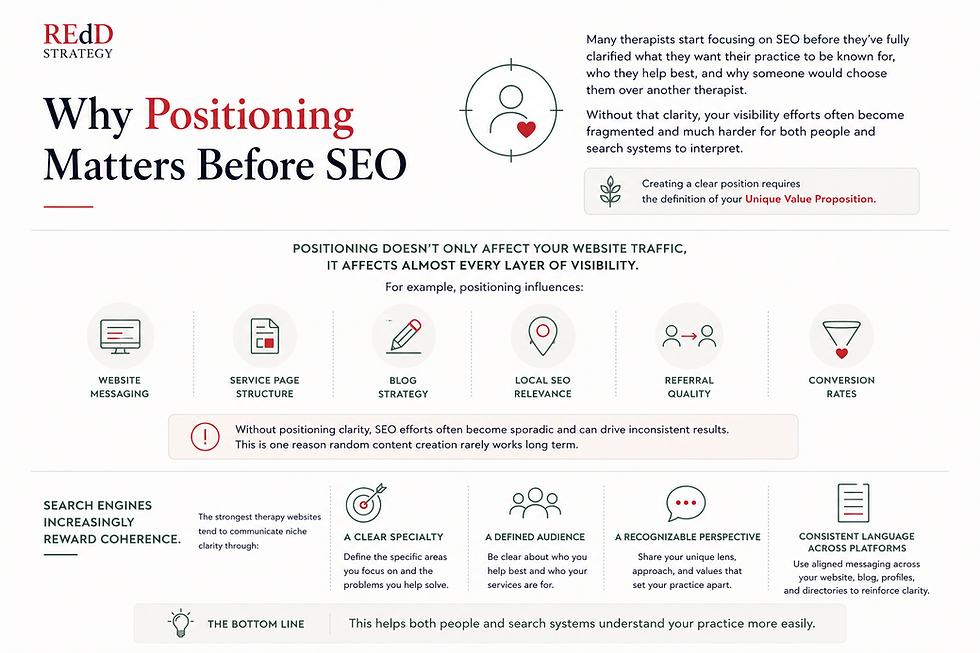
Many therapists start focusing on SEO before they've fully clarified what they want their practice to be known for, who they help best, and why someone would choose them over another therapist. Creating a clear position required the definition of your Unique Value Proposition. Without that clarity, your visibility efforts often become fragmented and much harder for both people and search systems to interpret.
Positioning doesn't only affect your website traffic, it affects almost every layer of visibility.
For example, positioning influences:
website messaging
service page structure
blog strategy
local SEO relevance
referral quality
and conversion rates.
Without positioning clarity, SEO efforts often become sporadic and can drive inconsistent results. This is one reason random content creation rarely works long term.
Search engines increasingly reward coherence.
The strongest therapy websites tend to communicate niche clarity through:
a clear specialty
a defined audience
a recognizable perspective
and consistent language across platforms.
This helps both people and search systems understand the practice more easily.
The Role of Content in Modern SEO
Creating content still matters deeply for therapist SEO, but the purpose of it has evolved.
Blogging is no longer simply about publishing large amounts of information. We already have an overabundance of human and AI generated content. What's being increasingly prioritized is a coherent, interconnected, and reputable authority content.
Let me break down what high-performing content is in practical terms:
answer relevant client questions
reinforce specialization
improve interpretability
build trust before consultations
and strengthen topical authority.
This is particularly important for private-pay practices where trust and perceived expertise strongly influence decision-making.
The goal of good content is to help potential clients feel understood, reassured, informed, and confident enough to take the next step, and book an appointment. And increasingly, content also helps AI systems understand how your practice fits within larger topical categories
Why Local SEO Still Matters
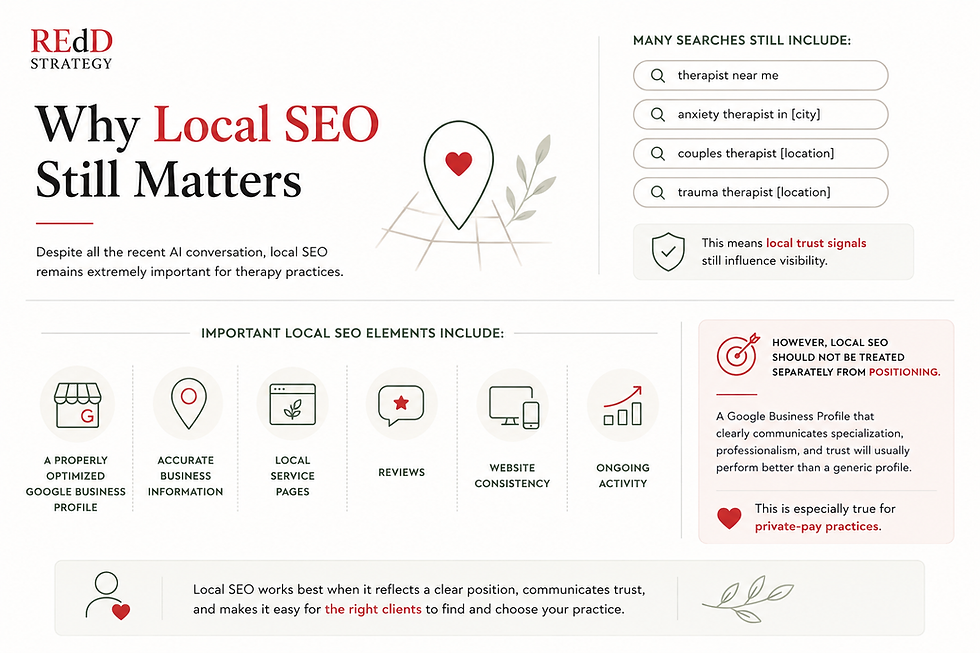
Despite all the recent AI conversation, local SEO remains extremely important for therapy practices. Despite the widespread adoption of telehealth, people still prioritize therapists close to their locations.
That's why many searches still include:
therapist near me
anxiety therapist in [city]
couples therapist [location]
trauma therapist [location].
This means local trust signals still influence your visibility and boost your reputation. Here are important local SEO elements include:
a properly optimized Google Business Profile
accurate business information
local service pages
reviews
website consistency
and ongoing activity.
Still, local SEO should not be treated separately from positioning. A Google Business Profile that clearly communicates specialization, professionalism, and trust will usually perform better than a generic profile. It's especially true for private-pay practices.
Why Psychology Today Still Matters
Some therapists assume Psychology Today and other directories no longer matter because clients now discover providers in so many different ways. But that’s not really what I’m seeing. People still use directory profiles heavily when researching therapists, especially in private-pay practice. The difference is that clients are no longer treating these profiles as the starting point alone. They’re using them to compare therapists, validate credibility, and get a quick sense of fit before deciding whether to move forward.
That means a weak or generic profile can quietly reduce conversions, and hurt your chances to keep your caseload consistently full.
Here's what I recommend for a strong Psychology Today profile:
reinforce specialization
sound emotionally clear
communicate fit quickly
and align with the rest of the practice’s visibility system.
The goal here is to add another layer of trust, and stand out from from other therapists on teh platform.
Understanding AI Visibility for Therapists
AI is beginning to reshape how healthcare information is discovered online.
Potential clients increasingly interact with:
AI summaries
conversational search
voice search
and recommendation-style search experiences.
This means visibility is becoming more contextual. Practices that are easier to interpret across platforms may become easier for AI systems to reference and summarize.
This is one reason misaligned visibility creates problems.
If your website, directory profiles, service descriptions, reviews, and content communicate the different things, trust weakens and search engines will deprioritize your visibility. So consistency matters more than ever.
The practices that tend to perform best online usually reinforce the same positioning repeatedly across ALL platforms.
Why SEO Should Support a Larger System
One of the biggest mistakes therapists make is treating SEO like an isolated marketing tactic.
Sustainable private-pay practices are rarely built through one tactic alone. Typically, it's one element of an entire private practice system.
That's why SEO works best when it reinforces your positioning, reeferral systems, operational expenses, conversion process, and trust. For example:
Strong positioning improves SEO clarity.
Good operations improve client experience.
Better conversion systems reduce inquiry drop-off.
Clear financial goals improve strategic marketing decisions.
Referral trust strengthens authority.
These systems reinforce one another. That’s why I often describe SEO as a stabilizing visibility layer rather than a traffic tactic.
What Sustainable SEO Looks Like for Therapists
Most therapists don't need viral content, constant posting, aggressive funnels, or massive amounts of website traffic. What they usually need is a visibility system that clearly communicates who they help, what they specialize in, and why the right clients should trust them. They need clarity.
The strongest therapy visibility systems are usually:
easy to understand
professionally cohesive
aligned with specialization
operationally consistent
and trust-oriented.
That’s particularly true for boutique, concierge, and private-pay practices. When a practice is positioned clearly and reinforced consistently across platforms, it becomes easier for:
search engines
AI systems
referral partners
and potential clients
to understand why the practice matters.
That creates stronger long-term visibility than chasing traffic spikes.
Final Thoughts
SEO for therapists is evolving because the way people search for healthcare providers is evolving too. The practices that tend to perform best online today are usually not the ones chasing algorithms or publishing endless amounts of content. They’re the practices that communicate a clear specialty, a strong point of view, and a consistent experience across platforms. In other words, the practices that are easiest to understand and trust often become the easiest to find.
Visibility today is increasingly tied to interpretability.
When your online presence helps people and search systems correctly understand your practice, SEO becomes significantly more sustainable.
And in many cases, much more predictable.
Want to Go Deeper?
Join me for a free masterclass:
AI Visibility for Therapists:
How to Avoid Becoming Invisible in the Age of AI Search
What to Do Next
If your practice feels visible online but growth still feels inconsistent, the issue may not be traffic alone. It may be positioning clarity, fragmented visibility, or a lack of alignment across your online presence.
The Private-Pay Framework breaks down the systems behind sustainable visibility, trust, referrals, and long-term private-pay growth.
OR
FAQ: SEO for Therapists
What is SEO for therapists?
SEO (Search Engine Optimization) for therapists is the process of improving your online presence so that your website and services appear in search engine results when potential clients look for therapy or mental health support.
Why is SEO important for a private practice?
With most people turning to Google to find healthcare providers, strong SEO helps ensure that your website is visible, trustworthy, and easy to find—leading to more inquiries and better-fit clients.
How long does it take for SEO to show results?
SEO is a long-term strategy. While some improvements (like speed or structure fixes) can have quick effects, content and backlinks often take 3–6 months or more to significantly improve rankings.
Can I do SEO myself or do I need a professional?
You can start basic SEO yourself by creating useful content, optimizing your website, and claiming local listings. However, hiring a professional can accelerate results and ensure you're using best practices.
What keywords should therapists target?
Start with terms your ideal clients might search like “anxiety therapist in [your city],” “couples therapy,” or “online therapy near me.” Use tools like Ubersuggest or Google’s Keyword Planner to refine your list.


