
Therapy Business Coach: How to Choose the Right Help for Your Private Practice

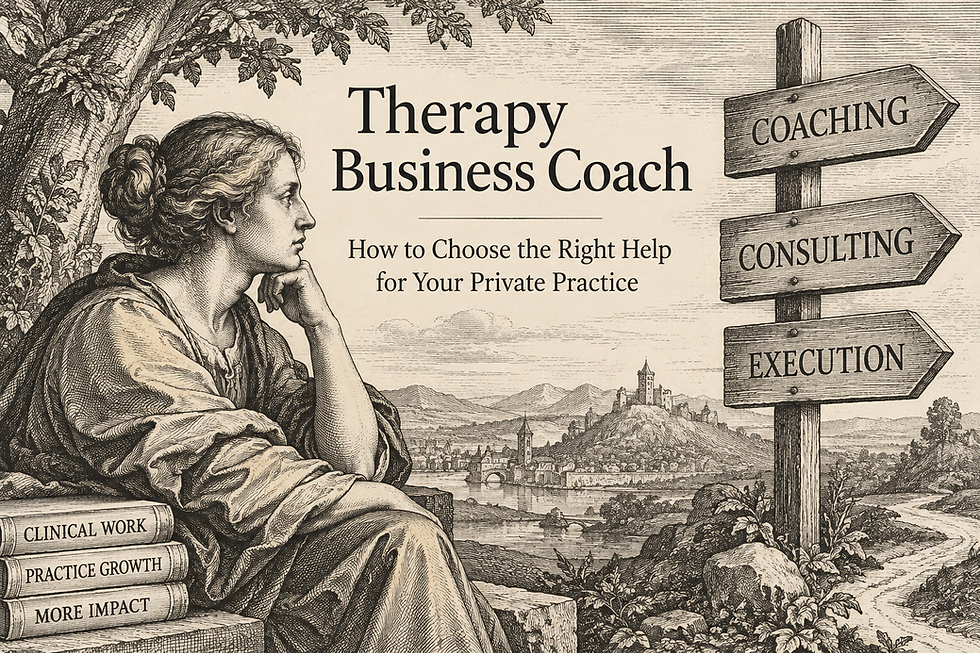
Should you hire a therapy business coach?
I think that the answer depends less on the title of the person you want to hire and more on what you need that person to help you do.
Maybe you need someone to help you think through decisions, develop your skills as a business owner, stay accountable, and provide perspective when you are too close to the business to see things clearly. Maybe you need someone with specific expertise to look at the practice and determine why it isn't growing the way you expected. Or maybe you already know what needs to change and simply need someone capable of implementing it.
Those are different problems. And they require different kinds of help.
This is where I think practice owners can get in trouble when searching for business support. “I need a business coach” sounds like a diagnosis, but it may actually be just a guess.
Similar thing happens with marketing all the time. A therapist decides they need SEO when the real problem is positioning. They decide they need more visibility when people are already finding the practice but aren't contacting it. Or they decide they need better marketing when something about the market, pricing, or business model deserves attention first.
So before asking if you should hire a therapy business coach, I would ask a slightly different question: What do you need help figuring out?
What Does a Therapy Business Coach Actually Do?
First, let me define what I mean by therapy business coaching.
A therapy business coach generally helps therapists navigate the business side of private practice. Depending on the coach and their expertise, that might include decisions about marketing, pricing, referrals, hiring, leadership, practice growth, or how the business itself is structured.
A good coach can provide perspective, accountability, guidance, and an ongoing sounding board.
But I don't think the value of coaching is simply that someone knows more about business than you do. Coaching can be particularly valuable because running a practice requires you to continually make decisions, and knowing something intellectually is very different from being able to evaluate options and act on them when you are inside your business every day.
A good coach can provide perspective, accountability, guidance, and an ongoing sounding board. They can challenge assumptions, help you develop business skills, and help you follow through on decisions you might otherwise continue reconsidering. For some practice owners, that's exactly what's missing.
The trouble is that therapy business coach is an extremely broad category. One coach may specialize in helping therapists start private practices. Another may work primarily with group practice owners. Someone else may focus on leadership, finances, marketing, or private-pay growth.
This is why I wouldn't evaluate someone simply by asking: Are they a business coach for therapists? I would want to understand what role they are going to play in solving the particular problem in front of me.
And this is where the distinction between coaching, consulting, and execution becomes useful.
Coaching, Consulting and Marketing Execution Solve Different Problems
There's certainly an overlap between these categories. A consultant may coach a client through a difficult decision. A coach may make recommendations based on their expertise. An agency may uncover strategic problems while implementing marketing.
So I wouldn't get overly attached to the labels.
Instead, I think about the primary job each type of support is being hired to perform.
Coaching helps you think and develop.
Consulting helps diagnose and determine direction.
Execution helps get the work done.
Coaching makes sense when you have some clarity about where you are going but need help navigating the decisions required to get there. You may need accountability, perspective, guidance, or someone who can help you evaluate opportunities and stay focused. In that situation, part of the value is developing your own capacity as a business owner.
Consulting becomes more relevant when the problem itself is unclear.
Let's say your private-pay practice isn't growing the way you expected. You're not getting enough inquiries, the inquiries aren't from the clients you want to attract, or you have invested in marketing without seeing enough movement in the business. Before deciding what to do next, someone needs to understand why.
Is your marketing message too broad?
Are you trying to reach a viable market?
Does your pricing make sense for the clients you're trying to attract?
Are enough right-fit people finding the practice?
When they find you, do they understand why they should choose your practice?
Are people showing interest but not taking the next step?
Within my Private Pay System™, I often look at those questions through positioning, visibility, trust, and conversion. But sometimes the issue isn't just marketing. The business model, market, pricing, capacity, or another business decision may be in a way.
This is where consulting differs from coaching. The consultant isn't primarily being hired to help you follow through on a direction you have already chosen. You are hiring them for their expertise in determining what the problem is and what should change.
Then there is execution.
An SEO company, web designer, advertising specialist, copywriter, or marketing agency is generally being hired to produce or implement something. That becomes valuable when there is enough clarity about what should be implemented and why. The problem is that practices often buy execution before answering the strategic questions.
If your positioning is unclear, driving more traffic to your website may simply expose more people to unclear positioning. If you're going after a market that can't support the business you're trying to build, better marketing execution is probably not going to solve that problem either.
So the question is not: Do I need a coach, consultant, or agency?
It's: Do I need help making decisions, determining the direction, or executing the work?
What Moving From Marketing Coaching to Growth Consulting Taught Me
And sometimes the most valuable recommendation wasn't about what they should do next. It was about what they should stop spending money and time on.
I came to this distinction partly through my own decade-long work.
I used to work as a marketing coach for therapists, and there were clients for whom coaching was exactly what they needed. They wanted feedback on their marketing, help making decisions, accountability around implementation, and someone who understood private practice marketing to serve as a sounding board.
But over time, I noticed that the questions clients were bringing me were changing. They weren't simply asking how to execute a marketing idea or how to stay consistent with a plan. They were asking why their private-pay practice wasn't attracting enough right-fit clients in the first place.
Was the positioning strong enough?
Were they pursuing the right audience?
Did the offer and pricing make sense for that market?
Was visibility actually the problem?
Should they invest in SEO, content, advertising, referral development, or something else?
And sometimes the most valuable recommendation wasn't about what they should do next. It was about what they should stop spending money and time on.
Those are different kinds of questions. To answer them, I needed to look beyond my client's consistent marketing implementation. I needed to look at the practice, the market, the positioning, the business model, the competitive environment, and the existing marketing system and form an opinion about what I thought was actually happening.
That gradually changed the nature of my work from marketing coaching toward growth consulting and strategic advisory.
It wasn't because I decided that consulting was better than coaching. I changed because the problems I was being asked to solve required diagnosis and strategic recommendations.
That experience also made the distinction much clearer to me. If someone needs accountability and perspective, giving them another strategic analysis may not solve their problem. But if they need someone to figure out why the practice isn't growing, accountability can simply make them more consistent at working on something that's not the actual problem.
Do You Need Coaching, Strategy or Execution?
A useful way to think about this decision is to ask what you expect another person to contribute that is currently missing.

Of course, a practice can need all three at different points. You might need strategic consulting to identify the problem, a specialist or agency to implement part of the solution, and ongoing coaching or advisory support as new decisions emerge. But the sequence matters!
If you know what needs to happen but constantly struggle to make decisions or follow through, coaching may be exactly the right investment. If you already have a clear strategy but lack the expertise or capacity to implement it, more coaching may not address the bottleneck. And if you're looking at your practice thinking, “I don't actually understand why this isn't working,” I would be cautious about jumping directly into either coaching or execution. That is a diagnosis problem.
How to Choose the Right Business Help for Your Therapy Practice
Once you understand the role you need someone to play, evaluating providers becomes much easier.
I wouldn't start by asking whether someone is a good therapy business coach. I would start by asking, What kinds of problems is this person particularly good at solving?
Someone can have extensive experience working with therapists and still specialize in a completely different type of problem than yours. A coach who is excellent at helping therapists open their first solo practices may not be the right person to diagnose why an established private-pay group practice has plateaued. Likewise, an SEO provider may be very good at SEO without being the right person to determine whether search visibility is where your practice should invest next.
There's another question I think is particularly important when you aren't sure what is wrong: What happens when this person thinks your original diagnosis is wrong?
Imagine you approach someone saying, “I need SEO.” If their business provides SEO, it would be completely reasonable for the conversation to become an SEO conversation. The same is true if you approach a coach saying, “I need business coaching.”
The issue isn't that either provider is doing something wrong. The issue is whether you are hiring someone to help determine the solution or hiring someone to provide a solution you have already selected.
That distinction should also influence how you think about cost. Therapy business coaching is sold in many different formats, including individual sessions, group programs, ongoing packages, and higher-touch engagements. Consulting can be structured as a single strategic engagement, a project, or ongoing advisory work. Execution has its own pricing models.
There isn't a reliable industry benchmark I would use to tell a therapist what business coaching “should” cost because these aren't interchangeable services. A better question is: Are you paying for the kind of help you actually need?
I would also look carefully at relevant experience. Growing a private-pay practice involves different questions than building an insurance-driven practice. An established group practice may have different constraints than a new solo practitioner. And attracting clients for a highly specialized, higher-fee service can require different business and marketing decisions than simply filling available appointments.
You need to understand what problem you're actually trying to solve.
If that's where you are, a Strategic Direction Call is a paid 60-minute working session designed to identify the biggest growth constraints in your practice and determine what deserves your attention next. It isn't ongoing therapy business coaching or marketing implementation.
The purpose is to clarify the problem, establish priorities, and determine the strategic direction before you invest additional time or money solving the wrong thing.
Frequently Asked Questions
How much does therapy business coaching cost?
There isn't a reliable industry benchmark I would use to tell therapists what business coaching should cost. Coaching is offered through individual sessions, group programs, ongoing packages, and more intensive engagements, so comparing prices without comparing the scope of the work can be misleading. Look at what is included, the provider's relevant expertise, how personalized the work is, the level of access you receive, and what you are actually hiring that person to help you accomplish.
Can a therapy business coach also be a consultant?
Yes. The labels overlap, which is why I would pay more attention to how someone works than what they call themselves. If they are primarily helping you think through decisions, develop your own skills, and stay accountable, the work is functioning more like coaching. If you are relying on their expertise to analyze the business, diagnose a problem, and recommend what should change, the work is functioning more like consulting.
Should I hire a therapy business coach or a marketing agency?
Start with what is missing. If you need guidance, accountability, and help navigating business decisions, coaching may make sense. If you have a clear marketing strategy but lack the expertise or capacity to implement it, you may need an agency or specialist. If you aren't yet sure why growth has stalled or what should be prioritized, diagnosis and strategy should probably come before implementation.


